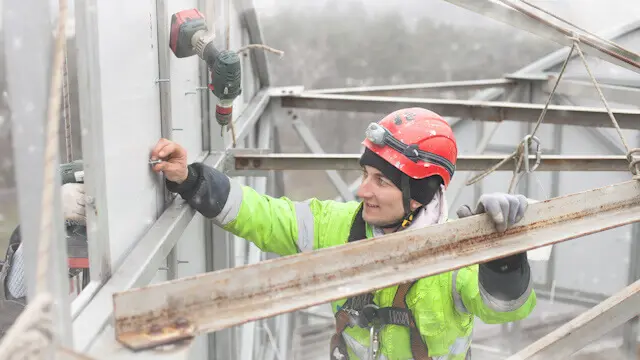
Invisible Hazards on Construction Sites: Working at Heights
On a construction site, working at heights is part of daily life for many workers. Whether it’s installing roofs, performing finishing work, laying materials, clearing snow, or working on a structure, these tasks involve risks that can have serious consequences, even when they seem routine.
The problem? When you repeat the same actions over and over, it’s easy to take the danger for granted. A quick action, a piece of protective gear temporarily removed, or equipment used out of habit can be enough to create a risky situation.
And contrary to what one might think, wearing a safety harness isn't a cure-all.
The danger does not depend solely on height
When we talk about working at heights, we automatically think of falls from a roof, scaffolding, or a platform. However, the risk also depends on the work environment, the surfaces, the equipment used, and how the tasks are organized.
A temporary opening in a floor, a fragile surface, an unprotected roof edge, or an improperly secured platform can put a worker at risk of falling.
That is why safety precautions must be considered even before the worker begins working at heights.
The harness: an important safety measure for working at heights, but not always the first choice
A safety harness is essential equipment in certain situations. However, it is important to distinguish between measures that prevent a fall and those that are used to stop one.
When discussing prevention in the context of working at heights, it is important to evaluate measures that eliminate the risk and protect all workers before considering personal protective equipment.
For example, depending on the task and site conditions, it may be possible to:
- perform part of the work from the ground;
- use a lift platform that complies with applicable requirements;
- install guardrails or other appropriate collective protection;
- use a travel restriction system;
- Use a fall-arrest system when other measures do not provide the required protection.
The choice of method must take into account regulations, the task at hand, and the characteristics of the worksite. A poorly fitted harness, connected to an inadequate anchor point or used without an appropriate system, does not guarantee effective protection.
In addition, safety harnesses must be inspected regularly to ensure their effectiveness and integrity. According to the CNESST, a periodic inspection—conducted by a certified professional in accordance with the manufacturer’s requirements and CSA standards—must be performed at least once a year.
Our team is certified to inspect safety harnesses. If you need to have these inspections performed, please contact us.
Prevention starts with planning
Safety when working at heights does not depend solely on individual behavior. It also depends on decisions made in advance by managers, employers, and site supervisors.
Before work begins, several questions should be asked:
- Can the task be performed without putting a worker at risk of falling?
- Are the appropriate collective safeguards in place?
- Is the selected equipment suitable for the planned work?
- Are workers aware of the risks and the measures they should take?
- If a fall-arrest system is required, is the rescue procedure ready and applicable to the actual conditions at the construction site?
These checks make it possible to shift from an approach that reacts to danger to one that seeks to prevent it.
Vigilance that must never become a habit
Working at heights is a reality of the construction industry. However, the risks involved should never be considered inevitable.
For workers, this means recognizing hazardous situations and reporting missing protective equipment. For managers, this means planning tasks, providing appropriate protective equipment, and ensuring that the required measures are actually implemented.
The best protection against a fall is the one that prevents it from happening in the first place.
The APECQ encourages contractors and construction crews to make prevention an essential part of their work practices, so that every worker can perform their duties safely.
To learn about the requirements for working at heights, Review the CNESST Safety Code or contact our occupational safety and health team to take action and focus on prevention.